For many students, transferring to a new university is a valuable opportunity—whether that means moving from a community college to a four-year school or switching to a university that’s a better fit. While the transfer application process shares some similarities with applying as a high school senior, there are important differences that families should understand.
Transfer students generally fall into two groups. The first—and largest—consists of community college students seeking a bachelor’s degree. Because community colleges typically offer only associate degrees, students who want a bachelor’s degree will need to transfer to a four-year university. Many public universities, especially those within the same state system, are designed to welcome community college students and often have dedicated pathway programs to make the transition smoother.
The second group includes students already at a four-year university who feel their current school is not the right fit. These students will need to articulate a clear reason for wanting to transfer—perhaps their school doesn’t offer the specific major or program they want, or the campus culture doesn’t align with their needs.
All transfer applicants need to clearly explain why they want to transfer to a particular school. There should be a well-defined plan for how the student will continue their education and why this specific university is the best fit for their academic goals.
Unlike freshmen, who can keep their academic goals somewhat broad, transfer students need to be much more specific about what they plan to do after they arrive. At most universities, the first two years are spent completing general education requirements and major prerequisites—a time when students can still explore their interests. The final two years, however, are far more focused: students take upper-division courses in their major, often choose a concentration, and are expected to draw clear connections between their past experiences and their readiness to succeed in advanced coursework.
In other words, transfer students need to show not only a clear direction within their major, but also that they are prepared to hit the ground running on day one, since they will be jumping straight into upper-division classes.
For example, a student transferring as a biology major shouldn’t simply say they want to study biology. They should specify whether they intend to focus on microbiology, integrative biology, bioengineering, biochemistry, marine biology, or another area. They should then explain why their target school’s program in that concentration is the right fit, citing specific courses, research opportunities, faculty, or other resources.
The bottom line: your student should present a clear master plan for the two years they’ll spend at the new school, demonstrating that they are ready to make the most of every opportunity from the start.
Most students transfer after their second year of college. Universities generally require a minimum number of academic credits before accepting transfer students, and accumulating those credits typically takes about two years.
Some universities do allow transfers after just one year, but the University of California (UC) system, for instance, requires a minimum of two years of coursework. For community college students attending part-time, it may take longer than two years to reach that threshold. For these students, it can be helpful for them to transition to full-time enrollment at a community college before applying to transfer, as this demonstrates commitment and readiness for a full-time course load.
Students at California community colleges have a unique advantage: the state’s public higher education system is one of the strongest in the country. Both the University of California (UC) and California State University (CSU) systems have established pathway programs specifically designed to help California community college students transfer successfully.
The most well-known pathway is the Transfer Admission Guarantee (TAG), an agreement between California community colleges and six UC campuses: Davis, Irvine, Santa Barbara, Riverside, Santa Cruz, and Merced. If a student meets certain GPA requirements—often a 3.0 or above—they are guaranteed admission to at least one of these schools. The specific GPA requirements for each campus are shown below:

Beyond TAG, there are numerous programs that help community college students transfer, depending on their circumstances and the schools they are targeting. UC Berkeley, for example, offers the Transfer Alliance Program (TAP) through its Center for Educational Partnerships, providing students with free counseling and resources to support their transfer to Berkeley.
In addition to these programs, there are clear curricular guidelines for transferring. Until recently, students could complete the Intersegmental General Education Transfer Curriculum (IGETC) to satisfy most general education requirements before transferring to a UC. That has now been replaced by the California General Education Transfer Curriculum (Cal-GETC), which is the only pattern available for newly enrolling students. While each community college determines which of its courses meet these requirements, the UC system’s general Cal-GETC course requirements are shown below:

Another valuable resource for students looking to transfer is ASSIST.org, a website that allows students to verify whether the courses they’ve taken at their community college match the prerequisites required by their target university. This is an essential tool for making sure no time or credits are wasted.
Given the availability of pathway programs, the “2+2” plan—two years at a community college followed by two years at a university—offers compelling advantages. Students benefit from structured transfer opportunities and can save a significant amount of money on tuition during their first two years.
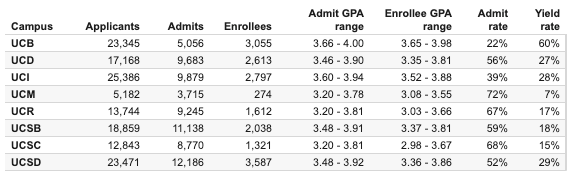
For the more selective UC campuses that do not participate in programs like TAG, admission largely depends on the major a student is applying to. Some high-demand majors, such as Computer Science, accept fewer than 5% of transfer applicants, while certain liberal arts majors may accept over 75%. You can review the raw transfer admission data for all UC campuses here:
The “2+2” model is not the right path for every student, but for families willing to plan ahead, it can be a strategic and cost-effective route to a degree from a top university.







.png)
.png)